 Kizuna
Pokéwalker API
Build on your Pokéwalker. Read how your walker is doing and add steps from your own apps: a watch, a phone shortcut or a small script.
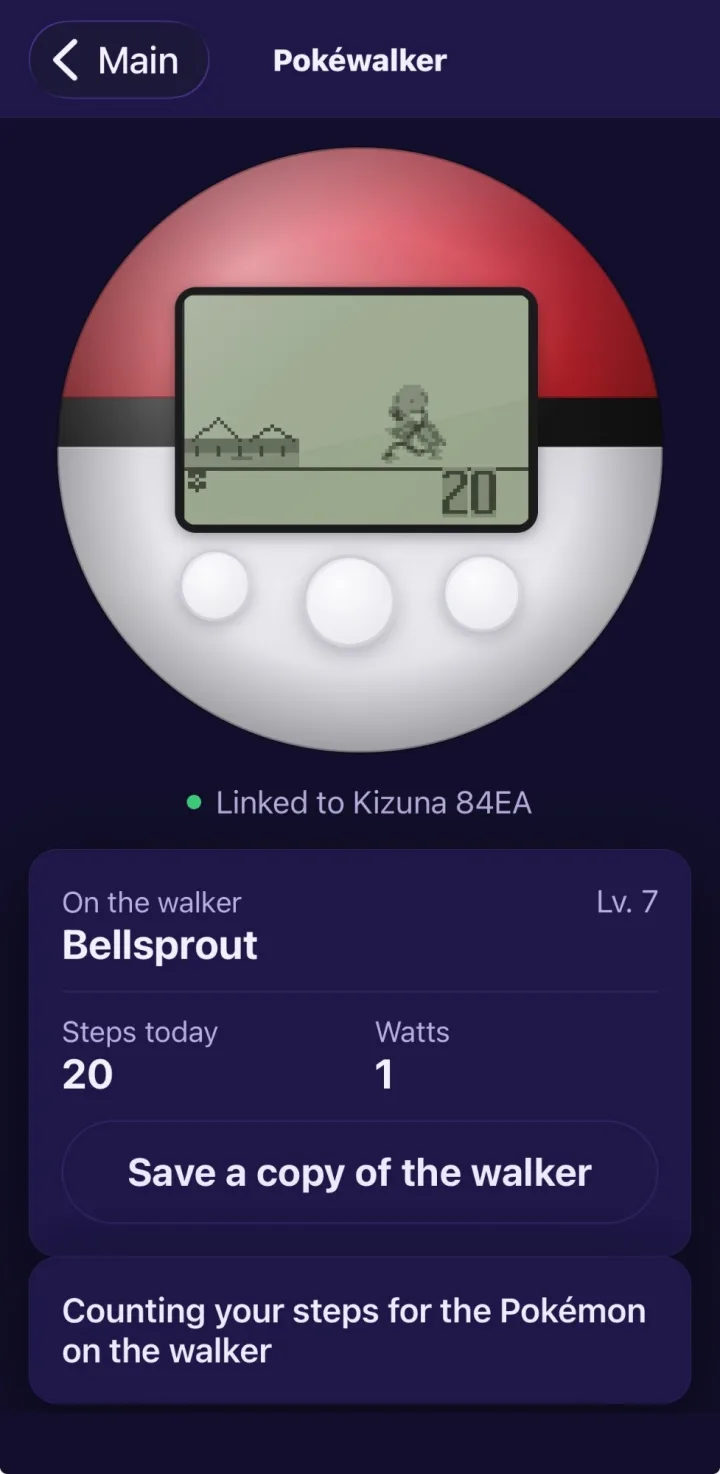
How it works
- Your walker lives in your Kizuna account. Your adapter stands in for the Pokéwalker, and the Kizuna app keeps your walker in your account: the Pokémon you sent from your game, its steps and its watts.
- Your apps add steps through the API. For example, a watch app sends the steps you walked each hour.
- The steps reach your game the next time you sync. When you connect your game to your walker with the Kizuna app, the steps you've added go with it. Until then they show as pending.
The API only reads your walker and adds steps. It can't change your Pokémon, your game or your account, and it never talks to your adapter directly.
Personal access tokens
Every request needs a personal access token. You create tokens in your Kizuna account, give each one a name (for example “My watch”) and choose what it may do. A token is shown once, when you create it. You can revoke it at any time.
| Permission | Lets the token |
|---|---|
walker:read | See your walker and the steps you've sent. |
steps:write | Add steps to your walker. |
Send the token in a request header, over HTTPS, like this:
curl https://api.kizuna.trading/v1/walker \
  -H "Authorization: Bearer kzw_pat_xxxxxxxxxxxxxxxxxxxxxx"
Treat a token like a password: don't put it in a URL, a public repository or a shared screenshot. If one leaks, revoke it in your account and create a new one.
GET/v1/walkerHow is my walker?
Who is walking with you, how many steps the walker has, and when it last synced with your game.
Permission: walker:read
GET /v1/walker

200 OK
{
  "pokemon": "Pikachu",            // walking with you now, or null
  "steps_total": 18340,            // steps on the walker at its last sync
  "steps_pending": 2210,           // steps you've added that reach your game at the next sync
  "watts": 917,
  "last_synced_at": "2026-11-26T09:14:00Z"
}POST/v1/walker/stepsAdd steps
Tell your walker you walked some steps between two times. Send them in batches, for example once an hour.
Permission: steps:write
POST /v1/walker/steps
Content-Type: application/json

{
  "id": "watch-2026-11-26T10:00",  // your own ID for this batch
  "steps": 1240,
  "from": "2026-11-26T09:00:00Z",
  "to":   "2026-11-26T10:00:00Z"
}

202 Accepted
{ "accepted": true, "steps_pending": 3450 }| Field | Meaning |
|---|---|
id | Any text up to 100 characters, unique to this batch. A batch sent again with the same ID (say, after losing signal) is not counted twice: the reply says it was not accepted. |
steps | Whole number of steps, 1 or more. |
from, to | When they were walked, in ISO 8601 time. The end must come after the start, and can't be in the future. |
GET/v1/walker/stepsWhat steps have I sent?
The batches you've added, newest first, and whether each has reached your game yet.
Permission: walker:read
GET /v1/walker/steps?limit=50

200 OK
{
  "batches": [
    { "id": "watch-2026-11-26T10:00", "steps": 1240,
      "from": "2026-11-26T09:00:00Z", "to": "2026-11-26T10:00:00Z",
      "synced": false }                // true once it has reached your game
  ]
}
Limits
| Limit | Value |
|---|---|
| Requests per token | 60 a minute |
| Steps added | 30,000 an hour and 100,000 a day per walker |
| Walkers per account | 1 |
Errors
Errors come back as JSON, with a short code and a message:
{ "error": "too_many_steps", "message": "…" }| Status | Meaning |
|---|---|
401 | The token is missing, wrong, expired or revoked. |
403 | The token doesn't have the permission this call needs. |
404 | You haven't set up a walker in the Kizuna app yet. |
422 | The request isn't valid, for example too many steps, or a period that ends before it starts. |
429 | Too many requests. Wait as many seconds as the Retry-After header says, then try again. |
Versions
Every path starts with the version, /v1. Changes that could break your app will come as a new version, announced here first.
Questions
API questions and early interest: support@kizuna.trading