 Kizuna
Bridging the GBA link port
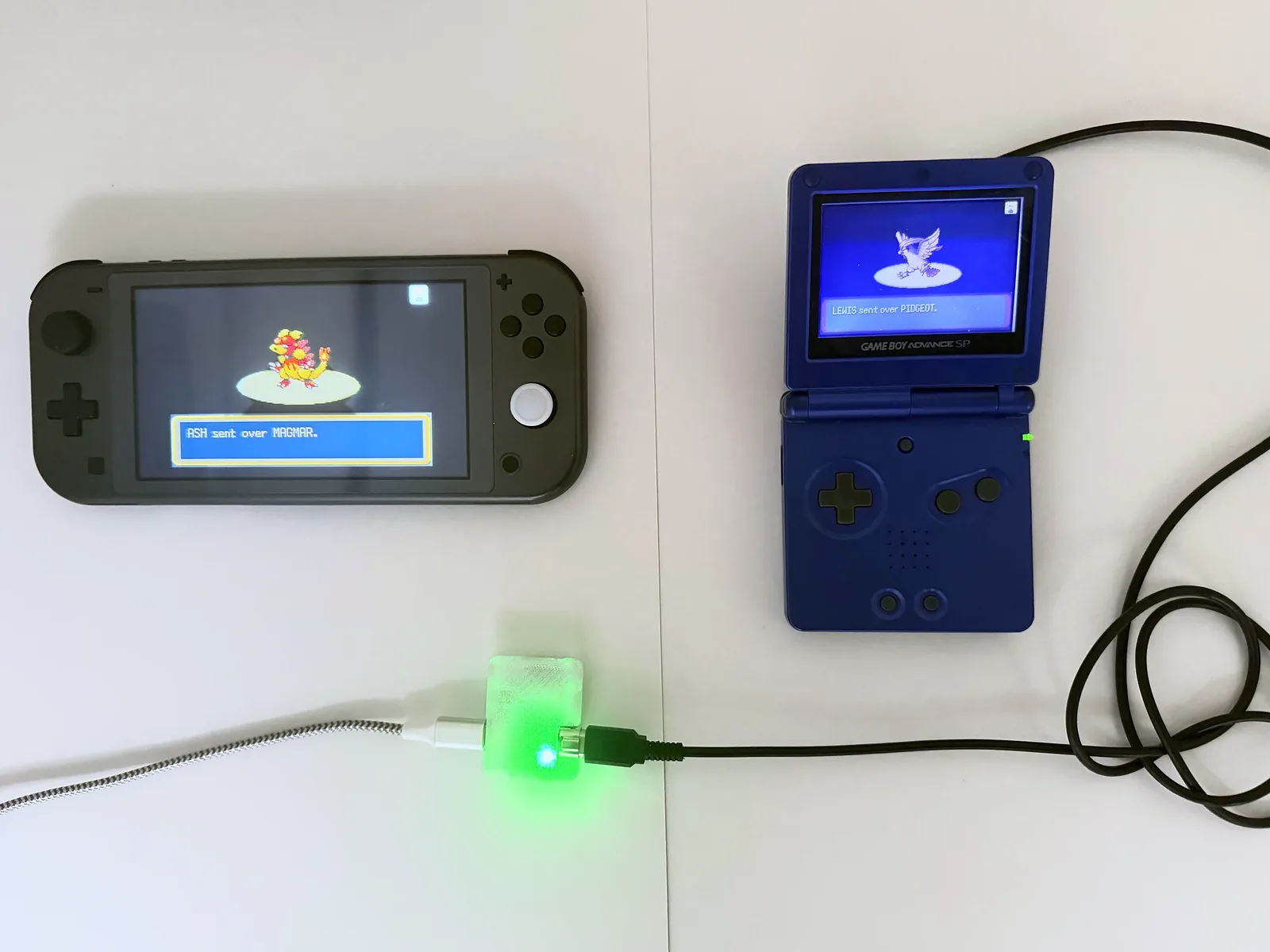
The Switch versions of Gen 3 only trade over local wireless. I built an adapter so a GBA cartridge can trade with them.
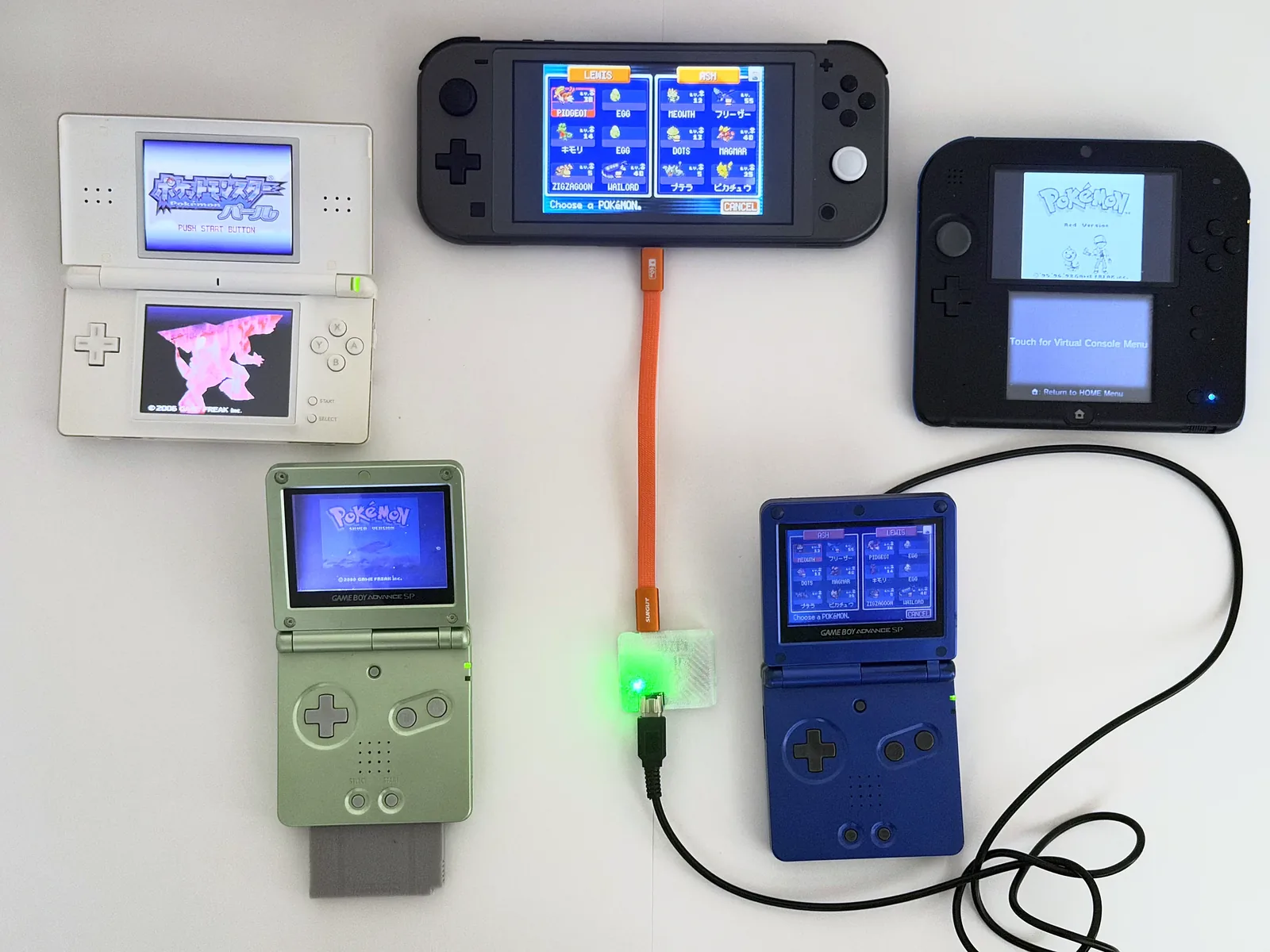
I make a small adapter called Kizuna. It plugs into the link port of a Game Boy Advance and lets a GBA cartridge trade Pokémon with the Switch versions of FireRed, LeafGreen, Ruby, Sapphire and Emerald.
I built it because the Switch releases only support local wireless. Two Switches in the same room can trade; anything further apart cannot. Nintendo has kept that behaviour since the originals, so it is unlikely to change now. Trading therefore needs another person, with another console and the same game, in the same room.
The Game Boy Advance has a link port. The Switch does not, so the adapter has to stand in for the console that would normally be on the other end of the cable.
What it does
When the Switch game looks for a trade partner, the adapter answers the way a second Game Boy would. The game opens its own trade menu, offers a Pokémon and waits. The adapter passes that session through to a real cartridge in a real GBA, which is doing the same thing on its side.
The game does the trade on both ends. The adapter does not create or edit Pokémon and does not write into either save file. It carries the link session and nothing else.
There are no buttons on the board. Setup, mode selection and updates happen in the phone app.
Save Vault
A GBA save sits in a battery-backed chip that is between twenty and twenty-five years old, and when that chip or its battery fails the save goes with it. Kizuna reads the save off the cartridge into the phone app, one entry per cartridge and per trainer, with the play time and the date, and keeps a copy in the cloud. Restoring asks for confirmation twice, because losing the wrong save is the mistake people actually worry about.
Game Boy and Game Boy Color cartridges work in the same slot.
What was hard
The link port is not a simple serial connection. The consoles depend on each other's timing, so an answer that arrives at the wrong moment is not read at all. Making one trade work took a while. Making it work every time, in both directions, took a lot longer, and the firmware has to recover timing rather than assume it.
The connector was the other problem. The pins sat slightly too shallow in the shell, and under the spring pressure of a real cartridge and console they would lose contact for a few milliseconds in the middle of a trade. Finding that took far longer than fixing it.
Remote play is the part I would call unfinished. The adapter can bridge two link sessions over a network, so a GBA can trade with a Switch that is not in the same room. It works, but it is a preview.
What it does not do
- It does not back up a Switch save.
- It does not move Pokémon between generations.
- It does not touch Pokémon HOME or Bank.
- It does not create, edit or import Pokémon.
- It is not approved by Nintendo, and a game update could break it. If that happens I will say so publicly.
Where it stands
Small handmade run, built in Japan, sold direct. Unofficial accessory, not affiliated with Nintendo, The Pokémon Company, Creatures or Game Freak. Support mail comes to me.
---